

In today’s competitive manufacturing environment, precision is everything. Industries such as aerospace, medical technology, and photonics rely on ultra-precision machining to produce components with exceptional accuracy and flawless surface finishes. When performance depends on microns—not millimeters—advanced CNC machining services become critical.
Ultra-precision machining combines high-performance hardware with intelligent software to deliver superior results. Let’s explore how this technology is transforming modern optical and precision manufacturing.
Ultra-precision machining (UPM) is an advanced manufacturing process designed to achieve extremely tight tolerances and high-quality surface finishes. Unlike conventional machining, which focuses on general production accuracy, UPM is engineered for sub-micron precision.
This process involves:
UPM is commonly used in optical component manufacturing, semiconductor production, aerospace systems, and medical devices where even microscopic deviations can impact performance.
Optical manufacturing requires near-perfect surface integrity. A minor defect can distort light, reduce efficiency, or compromise the entire system. Ultra-precision CNC machining ensures:
With advanced machining strategies such as NURBS-based toolpaths and point-cloud processing, manufacturers can create intricate optical components with confidence and repeatability.
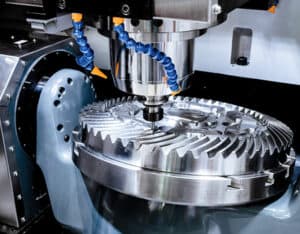
Despite its benefits, ultra-precision machining presents technical challenges that require specialized expertise.
Surface Finish Requirements at Sub-Micron Levels
Achieving mirror-like finishes requires vibration control, stable machine calibration, and precise cutting strategies.
Custom Optical Component Complexity
Modern designs often include steep radii, variable thickness control, and non-linear geometries. Multi-axis CNC capabilities are essential for handling these complex shapes.
Operating ultra-precision systems demands technical knowledge. However, intelligent automation frameworks now reduce manual intervention while improving consistency and efficiency.
Overcoming these challenges requires a combination of advanced equipment and strategic process optimization.
Technological innovation has significantly enhanced ultra-precision CNC machining performance.
5-Axis CNC Capabilities
Five-axis systems allow manufacturers to machine intricate parts in a single setup, reducing repositioning errors and improving surface continuity.
Multi-Threaded 64-Bit Toolpath Algorithms
High-speed computational processing generates machine-adaptive toolpaths quickly and accurately, increasing production efficiency while maintaining precision.
NURBS & Analytical Machining Strategies
Non-Uniform Rational B-Splines (NURBS) and analytical formulas enable precise shaping of complex surfaces directly from digital models, improving accuracy in optical manufacturing.
These technologies ensure faster calculations, smoother cutting motion, and optimized machine performance.
Precision manufacturing demands more than powerful machinery—it requires intelligent integration.
Toolpaths are automatically adjusted based on machine dynamics, ensuring smoother motion and improved surface finish.
Contact-point-based feedrate control enhances cutting stability, reduces vibration, and delivers consistent material removal.
Advanced 3D simulation predicts machine behavior and material removal before production begins, minimizing risk and improving efficiency.
Additionally, conventional CAM strategies such as drilling, roughing, and chamfering can be seamlessly integrated with ultra-precision cycles, offering maximum flexibility.
Ultra-precision machining supports innovation across multiple high-performance industries.
High-accuracy sensor housings, optical guidance systems, and structural components demand micron-level precision.
Surgical tools, imaging lenses, and implant components require smooth finishes and consistent tolerances to ensure safety and reliability.
Micro-scale components and wafer-processing equipment depend on flawless surfaces and exact geometries for optimal functionality.
These industries rely on ultra-precision CNC machining to meet strict regulatory and performance standards.
Traditional CNC machining is effective for general manufacturing applications. However, ultra-precision machining elevates the process by focusing on extreme accuracy, superior surface finishes, and advanced automation.
While conventional machining may achieve standard tolerances, ultra-precision systems are engineered for sub-micron control, predictive simulation, and optimized toolpath performance. For applications where precision directly impacts product functionality, UPM delivers measurable advantages.
Selecting the right CNC machining partner influences quality, efficiency, and long-term reliability. Our ultra-precision machining solutions offer:
By combining intelligent automation with high-performance machining systems, we help businesses meet demanding production goals without compromising precision.
If your project requires unmatched dimensional accuracy and optical-grade surface finishes, ultra-precision machining is the ideal solution.
Partner with a team that understands advanced CNC machining, complex geometries, and high-performance manufacturing standards. Contact us today to discuss your requirements and receive a customized quote tailored to your application.
Copyright © 2026 Coweta Tech Precision.